

That is why safety footwear is classified according to safety standards. These standards specify the level of protection a pair of shoes offers and the conditions under which they can be used. Within Europe, safety footwear is covered by the EN ISO 20345:2022+A1:2024 standard. This standard describes both the basic protection provided by a safety shoe and additional features, such as protection against sharp objects, moisture or slippery surfaces.
The basis of EN ISO 20345
All safety shoes compliant with this standard have, as a minimum, a protective toe cap capable of withstanding an impact of 200 joules. In addition, safety shoes often feature a number of standard characteristics, such as
- a closed heel for stability
- anti-static properties
- energy absorption in the heel for cushioning
Depending on the working environment, additional levels of protection may be incorporated.
The various safety standards form a layered system of protection. Each standard adds additional features to the previous one. For example, a safety shoe can offer extra protection against:
- sharp objects on the floor
- damp working conditions
- slippery surfaces
- heavy loads whilst working
The best-known standards within this hierarchy are S1P, S1PS, S2, S3 and S3S.
Safety standards
S1P safety standard
S1P safety shoes are designed for dry working environments where protection against sharp objects is required. A shoe meeting the S1P standard features, amongst other things:
- a protective toe cap
- antistatic properties
- energy absorption in the heel
- puncture protection in the sole
This standard is commonly found in sectors such as logistics and light industry.
S1PS safety standard
S1PS is a newer variant of S1P. The difference lies in the flexible, non-metallic puncture protection in the sole. This midsole can provide greater flexibility and freedom of movement whilst walking. S1PS is used, for example, in working environments where there is a lot of walking, bending or kneeling, such as electronics or installation engineering.
S2 safety standard
S2 safety shoes are designed for working environments where moisture is a factor, but where there is no risk of sharp objects on the floor. In addition to basic toe protection, an S2 safety shoe has a water-repellent upper that helps to keep feet drier. This standard is common in sectors such as:
- food industry
- healthcare
- facilities management
S3 safety standard
The S3 standard is intended for working environments where moisture and sharp objects are present. An S3-compliant safety shoe combines several levels of protection:
- safety toe cap
- water-repellent upper material
- puncture protection in the sole
- antistatic properties
- energy absorption in the heel
This makes S3 suitable for more demanding working environments such as construction, infrastructure and outdoor work.
S3S safety standard
S3S builds on the protection offered by S3. The main difference is that the puncture protection often consists of a flexible, non-metallic midsole. This can provide greater freedom of movement and comfort whilst walking.
S3S is often used in working environments where protection is required, but where flexibility and comfort are also important. Examples include industry, logistics and technical services.
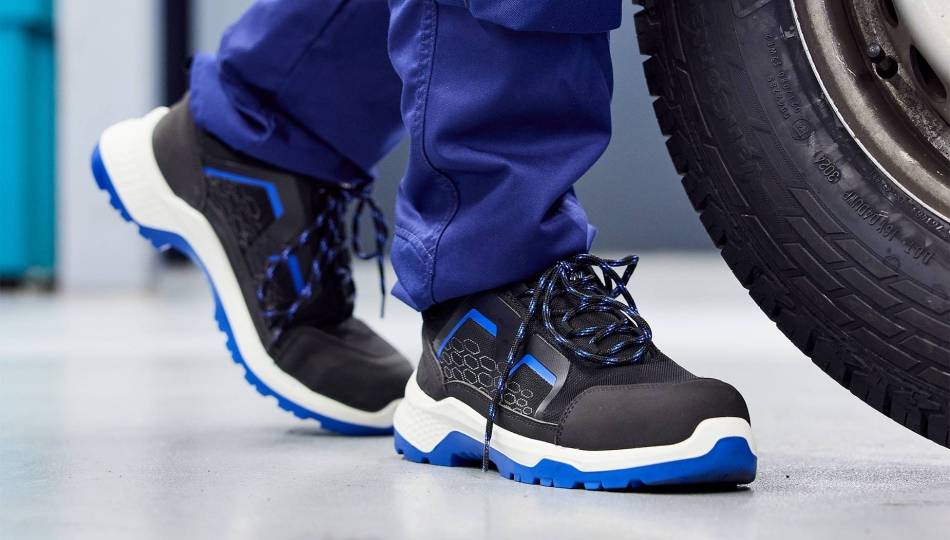
Work shoe standards without a safety toe cap
As well as safety footwear, there is also work footwear without a protective toe cap. These fall under standards such as O2 and O3. These shoes offer protection against, for example, moisture or sharp objects, but are intended for working environments where a protective toe cap is not mandatory.
Safety standards and additional classifications
In addition to the safety standard, safety footwear may also have additional classifications. These provide further information about specific properties of the footwear. Examples include:
- slip resistance (SR)
- ESD protection against static electricity
- puncture protection in the sole
- water resistance
These features work in conjunction with the safety standard to provide protection and comfort.
Choosing the right safety footwear
Choosing the right safety footwear always depends on the risks in the workplace. As well as safety standards, factors such as grip, fit, sole technology and working conditions also play a part. By choosing the right combination of standard and technology, feet remain protected and comfortable whilst working. Would you like to know which safety footwear is best suited to your job (and working environment)? Then complete the risk assessment and find the right safety footwear.[LINK TO BLOG ON SAFETY STANDARDS]