
Enter subtitle
Not every foot fits into a standard safety shoe. Sometimes extra support is needed. Or an adjustment to the fit. With EMMA’s orthopaedic solutions, it remains possible to work safely, even with specific foot problems.
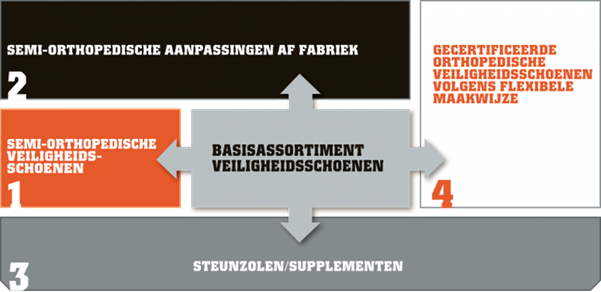
Within orthopaedic solutions, we distinguish between three levels:
- Semi-orthopaedic modifications to an existing safety shoe
- Support with a bespoke insole
- Fully bespoke safety footwear
The solution required depends on the foot and the working environment.
Semi-orthopaedic modifications
Semi-orthopaedic modifications are alterations made to an existing model of safety footwear. The basic structure of the shoe remains the same, but the fit or support is adjusted.
This may be necessary, for example, in the following cases:
- Leg length discrepancy (shortened leg)
- A thickening at the heel (Haglund’s exostosis)
- A bony protrusion on the instep (dorsal exostosis)
- A slight deviation of the big toe (hallux valgus)
- Limited mobility of the big toe (hallux limitus or hallux rigidus)
Semi-orthopaedic solutions may involve modifications to existing EMMA safety footwear or the use of a model with extra space, such as the Constans. These modifications are carried out in accordance with EMMA’s established guidelines. Only when the modification falls within these guidelines will the safety shoe continue to comply with the applicable safety standard.
We use the EMMA fitting van to measure for semi-orthopaedic solutions. With this mobile fitting service, specialists measure feet on site and immediately assess what adjustments are required. This results in a solution that suits both the wearer and the working environment.
Certified orthotic insoles with Hydro-Tec® Ortho Cover
In some cases, no modification to the shoe is required and an orthotic insole is sufficient. An orthotic insole can provide support for:
- Overuse of the heel or forefoot
- Instability whilst walking
- Flat feet
If a podiatrist or orthopaedic specialist fits their own orthotic in a safety shoe, this may affect the certification. A safety shoe must remain within the specified combination to comply with the safety standard.
That is why EMMA developed the Hydro-Tec® Ortho Cover. This cover allows a bespoke orthotic insole to be combined with certain EMMA safety shoes in accordance with the established work instructions. If the Hydro-Tec® Ortho Cover used in accordance with these guidelines and in combination with a suitable EMMA safety shoe? Then the shoe will continue to comply with EN ISO 20345:2022+A1:2024 and EN ISO 20347:2022+A1:2024
Hydro-Tec® Ortho Cover material is available via www.frecoma.nl. Are you a podiatrist or orthopaedic specialist and would you like to work with the Hydro-Tec® Ortho Cover? Register via the form.
Insole templates for
Ortho Cover
Insole templates are available for customising Hydro-Tec® Ortho Cover solutions. These cardboard insole templates are used to tailor the Hydro-Tec® Ortho Cover precisely to certified orthotic insoles. This enables the specialist to determine the correct shape whilst remaining within the prescribed combination.
Fully bespoke
safety footwear
Where semi-orthopaedic modifications or insoles are not sufficient, fully bespoke solutions are available. With bespoke solutions, the safety shoe is tailored to the wearer’s foot. Safety and certification remain paramount in this regard as well.
Find out more about the available models on the orthopaedic safety footwear page.
Advice on orthopaedic solutions
Orthopaedic solutions require expert guidance. EMMA works in partnership with orthopaedic specialists, podiatrists and authorised dealers. Would you like to find out which solution is right for your situation or organisation? If so, please contact an EMMA dealer or specialist.
Safety for everyone.
Frequently Asked Questions
Yes, but not every orthotic insole can simply be used in a safety shoe. Safety shoes are tested and certified as a combination of the shoe and the insole. If the standard insole is replaced, the certification may become invalid. That is why it is important to choose a solution that falls within the approved combination for the safety shoe.
Insoles for use in EMMA safety footwear are usually fitted by a podiatrist or orthopaedic specialist. They can assess which solution is suitable and what options are available within the applicable safety footwear certification.
The certification of safety footwear remains valid only if the insoles or modifications used have been officially approved for use with that particular shoe. In the case of orthopaedic safety footwear and certified solutions, the shoe continues to comply with the applicable safety standards.
EMMA’s Hydro-Tec® Ortho Cover makes it possible to use a bespoke orthotic in combination with certain EMMA safety shoes, whilst retaining certification. The cover material is fitted in accordance with set guidelines, ensuring that the safety shoe continues to comply with the applicable safety standards. An Ortho Cover solution can provide a solution when extra support is required, for example in the case of foot problems or instability whilst walking.
An orthopaedic safety shoe may be required when standard safety shoes do not provide sufficient support or comfort. For example, in the case of foot problems, pressure points, an abnormal foot shape or medical conditions affecting the feet. Orthopaedic safety shoes help you to continue working safely and comfortably.
Yes. EMMA offers certified orthopaedic safety footwear. We work in partnership with orthopaedic specialists for this. The specialist carries out the fitting and ensures the footwear is made to measure. The orthopaedic safety footwear is then manufactured in accordance with the applicable safety standards.
If a standard safety shoe does not provide sufficient support or causes discomfort, an orthopaedic solution may be the answer. This can range from a semi-orthopaedic modification to a bespoke insole or a fully bespoke solution.
With semi-orthopaedic solutions, an existing model of safety footwear is modified, for example by adding extra space or adjusting the fit. With fully bespoke solutions, the safety shoe is made specifically for the wearer’s foot. In between these two options lies the solution involving a bespoke arch support, which provides extra support without the shoe itself being modified.
Yes, provided that the combination of shoe and modification falls within the established guidelines. Always seek advice from a specialist to ensure that the safety shoe continues to comply with the applicable standards.